Warning
Note
On Sayaka
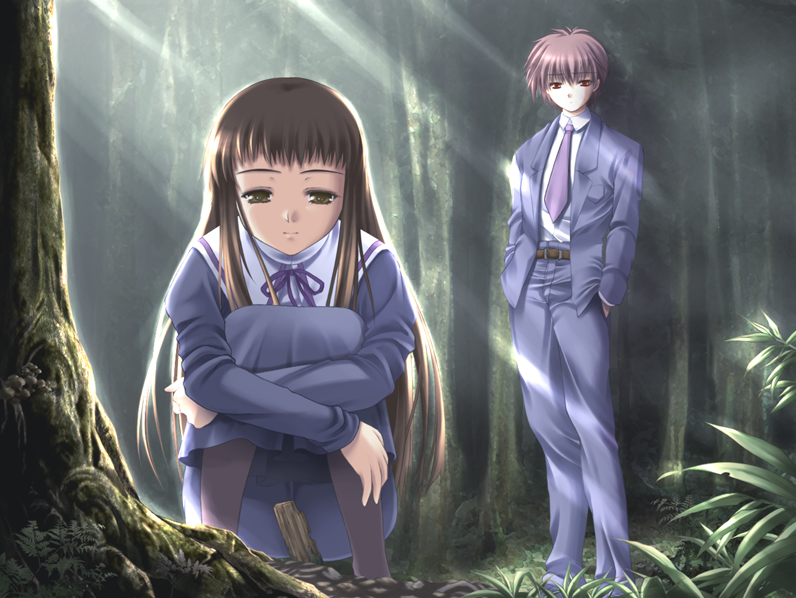
During Sayaka's route, Saihate no Ima drops us into yet another one of its fragmented scenes. This time, Shinobu and Sayaka are venturing through a forest (seemingly the same forest that we abruptly ended the route in during Azusa’s route because of the ominous “503 Service Unavailable” message). Here, Shinobu and Sayaka are here to visit the graves of the rabbits Buchi and Maru on their anniversary.
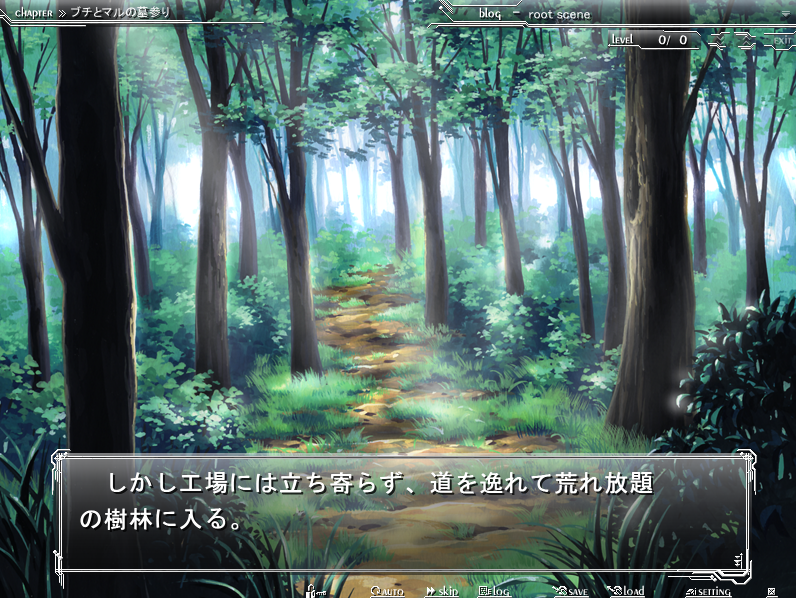
The description of the forest itself could be said to be quite interesting because it frames the forest as an ecosystem built upon separation and hierarchy. 「森の命は、天地にわかたれている。豊穣の大地と、青々と繁った樹冠部」 “The life of the forest is divided between heaven and earth. A fertile land and a lush, green canopy” (Xuse, 2015). The forest is not unified in some harmonious sense; rather, everything occupies its own layer, its own role. The things beneath the soil do not require light, whereas the trees above absorb that light. Basically, every single existence survives within its own specific boundary.
This naturally leads into the elder tree becoming the central symbol of their conversation. The tree is described as almost unnatural in its persistence; with its twisted trunks and branches reaching outward and entangling itself with younger trees, which give it the appearance of something that has remained long after the world around it had changed. Shinobu also remarks on its nature, while Sayaka explains that she found it while she was young, and that it has remained almost unchanged since then. Now, the reason I've been going on about this tree is because of what it represents to Sayaka, not just because it is connected to her memories of Buchi and Maru, but also because it represents a form of existence that she finds fundamentally different from her own. As in, the tree itself stands alone, but its solitude is not painful; it does not need recognition from anything outside itself. It simply just exists.
This is where Sayaka begins to reveal a bit of the way she understands herself.
Note
But this image of Sayaka as a completely self-sufficient individual is also where the contradiction begins. In school, as a child, she was treated as a “witch,” and because of the rumors and urban legends surrounding her that she never really bothered to correct (at least as far as I know while writing this, no comment on later—or past—events, you never really know with Saihate no Ima honestly,) she became something of a taboo figure among her classmates. Despite this, Sayaka does not describe her isolation as something that directly hurt her. Rather, the problem seems to lie elsewhere: in the fact that, regardless of how independent an individual may perceive themselves to be, they still exist as a human being within a larger—and importantly, social—world.
「孤独は私を傷つけなかったけれど、心の循環から外れた私は滋養を得ることはできず、摩耗していく自分を予見してきた」
“Loneliness didn’t hurt me, but being disconnected from the flow of my heart meant I couldn’t nourish myself, and I foresaw myself wearing down.” (Xuse, 2015).
The important distinction here is that Sayaka doesn’t say that loneliness itself destroyed her. Rather, she says that she was unable to receive nourishment because she existed outside “the circulation of the heart.” There is almost something biological about the way she frames human connection.
She immediately makes a comparison of a fish that is washed ashore, 「丘に打ち上げられた魚が過ごす最期の時のように」 “Like the last moments a fish spends after being washed ashore on a hill.” (Xuse, 2015). A fish does not suffer on land because it hates the land. It suffers because the environment it requires to exist is absent. In the same manner, Sayaka sees herself in a similar position: an existence can intellectually stand alone, yet whose physical and social reality still demands participation in something beyond herself.
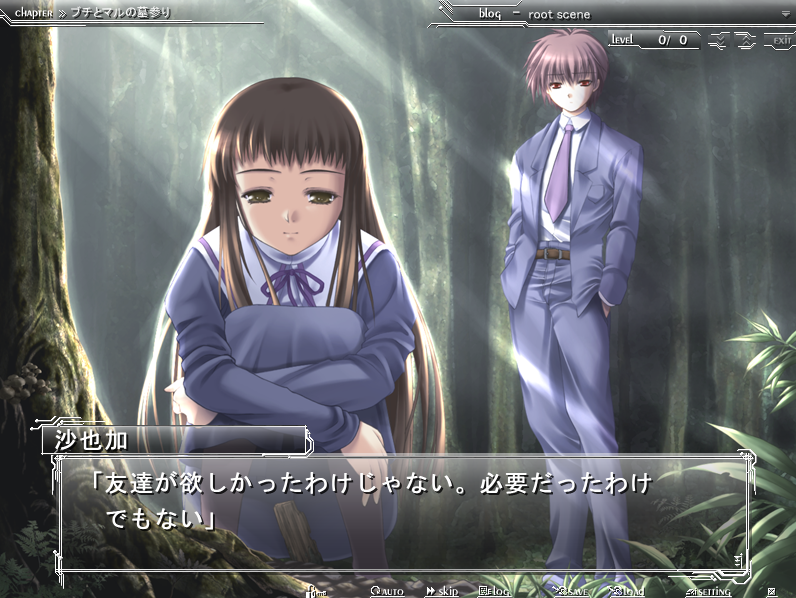
「友達が欲しかったわけじゃない。必要だったわけでもない」
“I didn’t want friends. I didn’t need them either.” (Xuse, 2015).
This line is perhaps the clearest expression of one of Sayaka’s contradictions. She doesn’t deny that she has relationships. Nor does she deny that she can appreciate them either. What she denies is the idea that they are fundamental to her existence. Friendships are just an external factor that happened to her, not something that completes her. Then, almost immediately, she undercuts herself. Her inner self may not need anyone, but, as she puts it, “this body needed society.” I also really like the wording here. Notice how she separates “I” from “this body.” It's a tiny distinction, but it tells you almost everything about how Sayaka thinks. Her consciousness sees itself as independent; her body stubbornly reminds her that it's still human. And because it is a human body, it grows tired, it breaks, and it requires the presence of others. She understands human connection while simultaneously feeling fundamentally separate from it. Which is also why she describes society as something she endured.
「社会に身を置くしかなかった」
“I had no choice but to put myself in society.” (Xuse, 2015).
Thus, to Sayaka, society is not a place where the self naturally develops. It is merely an external force that presses against the individual, although that pressure is not entirely negative either. In fact, the rest of this convo reveals that this pressure may be the very thing that prevents her from losing herself.
The Elder Tree
As the conversation continues, it begins to steer away from the idea of loneliness into something a bit more abstract: what kind of existence Sayaka believes would have suited her better.
When Shinobu asks her what she would have wanted to be born as, Sayaka answers: 「生まれたかったわけではないけど、適切だと思ったのは木かしらね」 “I didn’t necessarily want to be born, but I guess being a tree was the right choice for me.” (Xuse, 2015). While the answer may seem a bit strange, it becomes quite clear when she explains what a tree represents to her. 「木は心象領域において常に一人だわ。静的にシステムに組み込まれ、自由な思想が許される」 “In the realm of the mind, a tree is always alone. It is statically incorporated into a system, and its free thought is permitted.” (Xuse, 2015).
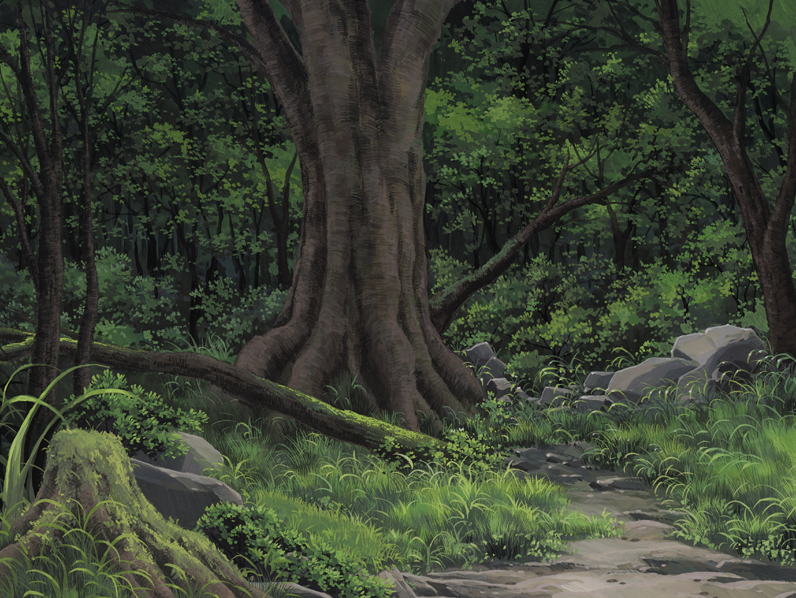
A tree is the ideal existence for Sayaka because it possesses individuality while also being free from social conflict. It is alone, but that loneliness is not a failure. I don't think anybody would complain about a tree being alone—unless you’re some sort of gardener that’s decorating a garden, perhaps, although maybe that is exactly the point. Who knows? Anyway, the point I'm getting at is that this solitude is not something imposed upon it; it simply belongs to the structure of its existence. Unlike humans, a tree does not have to negotiate between its internal self and the expectations of others. Nevertheless, Sayaka immediately undermines this ideal afterwards: 「もっとも彼らの心のほとんどは、ごくごく小さな火花のような刹那的なものだけれど」 “But most of their feelings are just fleeting, tiny sparks.” (Xuse, 2015). As said, trees possess only tiny sparks of feeling, yet they enjoy freedom precisely because their subjectivity remains so limited. Human beings, by contrast, possess expansive self-consciousness and therefore become trapped by endless reflexivity.
Shinobu then asks:
「その長老さんはどうなの?」
“What about that elder?” (Xuse, 2015).
「からっぽよ」
“It’s empty.” (Xuse, 2015).
The point is that, while the tree may appear to be the closest representation to what Sayaka’s ideal existence is, it is also a hollow existence. It has the appearance of something enduring, but there is nothing inside. Like any old tree, its rings testify to years upon years of growth, each one marking yet another year of its life, but there is no substance behind it. The tree has history, but history alone does not necessarily mean that there is something living within it. It has endured countless seasons, witnessed the passing of time, and remained standing long after the things around it have disappeared, yet all of that persistence ultimately amounts to nothing if there is no consciousness to experience it. Which is why the tree is such a fitting image for Sayaka’s fear. From the outside, it appears almost ideal: it is ancient, independent, and untouched by the conflicts that define human existence. Although Sayaka looks at it and instead of presence, sees only absence: 「大きな空間があるけど、そこに生きた魂はない」 “There is a large space, but there are no living souls there.” (Xuse, 2015).
In a way, the elder tree has achieved everything Sayaka believes she desires. But the conclusion she reaches is that such “freedom” is indistinguishable from emptiness. Perhaps a being without conflict is also a being without growth. In that perspective, the very things that burden us humans (the influence of others, the limitations of society, and the friction inevitably created through interactions and relationships) may also be the things that prevent us from becoming nothing more than empty shells.
The Size of the Self
After their conversation about the tree, Shinobu begins reflecting a bit on Sayaka's earlier statement about wanting to have been something that did not require others. This then evolves into a comparison between two different ways of confronting the same fundamental problem, what does a person become when there is nothing outside of themselves to define them?
When Sayaka asks Shinobu whether he has thought about the same thing, he answers, 「......いつも考えてる」 “...I’m always thinking about it.” (Xuse, 2015). Now, throughout Saihate no Ima up until this point, we have only had brief glimpses and short lines that vaguely hint at Shinobu’s past. This conversation does not necessarily expand upon it directly, but what we can take from it is the similarity between Shinobu and Sayaka, especially in how both of them exist apart from ordinary human interaction. Shinobu’s solitude is not that different from Sayaka’s on the surface. He also describes himself as someone who failed to understand ordinary human relationships. He also spent his childhood detached from others (in the inauspiciously mentioned facility), lacking the experiences that are normally considered essential to forming a person. We actually get a hint of this in Azusa's route:
「いつものように薬を服用すると、やることはなくなる。[...] 本当の意味でのプライベート空間は、忘れ去られた遺物に凝縮されている。ただ眠り、体を横たえるだけの部屋―――部屋は内面を映す。部屋の有り様は、心象世界そのものだ。かつて忍の内面は、機能だけであった。今は違う。違うはず。廃墟の内に宿った聖域。それは確かに、忍の心と言えるものではないだろうか。[...] 求められる要素は多くない。彼らが、いること―――仲間が一堂に会し、外界から守られていること。小さなコミュニティ。忍らにとって世界の全てに近い。[...] 世界は限りなく広大であるため、個体が全てを知覚することは不可能だ。[...] 自分の居場所があれば良い。だからこそ、衰退ははじまったのかも知れない。辿り着くのは、聖域の個室化でしかないのだから。一人一人のエゴと合致する心地よい場所は、心のうちにしかない。」
“As always, once the medicine has been taken, there remains nothing to do. [...] A space that can truly be called private has been distilled into forgotten relics. A room meant only for sleep—for laying one’s body to rest. A room reflects the one who inhabits it. The state of a room is nothing less than the landscape of the mind itself. Once, Shinobu’s inner world consisted of function alone. But not anymore. At least, it should not. A sanctuary dwelling within ruins. Could that not, indeed, be called Shinobu's heart? [...] Not much is required. Only that they are there— That companions may gather in one place, sheltered from the world beyond. A small community. For Shinobu and the others, it is almost the entirety of the world. [...] The world is immeasurably vast; no individual can ever perceive it in its entirety. [...] It is enough simply to have a place to belong. Perhaps that is why decline began. In the end, all that awaits is the partitioning of the sanctuary into solitary rooms. For the only place perfectly aligned with each person’s ego—the only place where one may feel entirely at ease—exists within the heart alone.” (Xuse, 2015).
I actually quite like this passage because, despite it coming from a completely different route, it almost reads like an answer to Sayaka before she even asks the question. It is one of those moments in Saihate no Ima that let its fragmented storytelling shine because it lets routes speak to one another without ever making it fully evident.
This passage functions as a direct counterpoint to Sayaka's idea of the tree. While both Shinobu and Sayaka seem to begin from a similar position (an existence that has been separated from ordinary human connection). Sayaka, however, views this separation as something close to an inherent characteristic of her existence, whereas Shinobu's room is only described as something that changes through the presence of others. His inner world was once only “function,” an empty space meant only to maintain the body, but it gradually becomes a “sanctuary” because there are people within it. Shinobu does not find completeness by becoming independent from everything else. Instead, the self is something that emerges through its encounters. In a way, it's almost obvious when you think about it. The world may be unimaginably vast, but an individual can never truly possess all of it; nobody meaningfully inhabits “the world.” We inhabit neighborhoods, friend groups, classrooms, Discord servers, workplaces—small pockets of reality that subtly become our entire universe. From this perspective, the “size” of the self is not infinite. It has to exist somewhere, within some sort of boundary, otherwise it simply expands into nothing.
Which is why Shinobu's own description of himself is quite important:
「僕は子供の頃、灰色の青春を過ごしたクチだからね」
“I spent a rather dull adolescence when I was a kid.” (Xuse, 2015).「人間性とか、身につけ損なってた」
“I missed out on developing my humanity.” (Xuse, 2015).
The difference lies in how the two interpret the same position. Sayaka views her separation from others as something almost fundamental to her nature. She sees herself as an individual who exists apart from the ordinary flow of human connection. Whereas Shinobu views his lack of connection as something incomplete. He does not think of humanity as something naturally contained within himself, but rather something external that he observes, studies, and attempts to “probe.” Hence the strange but fitting metaphor, 「僕は、プロープ(調査機)のようなものだ」 “I’m like a probe (surveillance device).” (Xuse, 2015).
(Granted, if someone compared themselves to a surveillance probe in an ordinary conversation, I'd probably have a few follow-up questions. But then again, this is Saihate no Ima, and comparing yourself to a piece of aerospace hardware is probably one of the more normal things someone says.)
There is also an interesting contradiction here, because Shinobu's method of defining himself is not actually as limitless as it first appears. Although he moves outward toward the world instead of retreating inward, he is still creating a boundary around himself through that choice. To say “I am someone who searches” is also to exclude countless other possibilities of what he could become. In that sense, Shinobu and Sayaka are not complete opposites. Sayaka fears that external boundaries will erase the self, while Shinobu discovers that a chosen boundary is what gives the self a recognizable shape. His freedom does not come from having infinite possibilities (like the sort of existential paralysis explored in The Man Without Qualities); it comes from deciding which possibility he will continue to embody.
A probe is an interesting companion since it implies an existence that is defined through observation. A probe doesn't explore because it has some personal desire to understand what it finds. It does not look outward because it is searching for companionship or because it feels complete. Like the probes we send into space, it just moves toward something unknown, collecting information and expanding the boundary of what it can perceive.
The funny thing about real-life probes is that they don't actually care about what they discover. Voyager isn't curious. Curiosity belongs entirely to the people who built it. The probe simply continues moving because that's what it was designed to do. Shinobu's relationship with humanity isn't all that different. He doesn't approach others because he believes they will fill some missing part of himself. He approaches them because understanding that external world has become the way he defines his own existence. When Sayaka asks him whether he searches for people (like how the seven of them actually met up) because he wants something from them, he denies this: 「個人の喜びのために人を捜すのではなく、ということ」 “It is not that I search for people for my own personal enjoyment.” (Xuse, 2015). And his follow-up answer is:
「自動的に生きてるようなものだ」
“It’s almost as if I am living automatically.” (Xuse, 2015).
Actually, Shinobu talks like this surprisingly often throughout Saihate no Ima, at least from what I have read. Describing himself in mechanical terms isn't really out of character. Much like the probe, he does not frame his actions as the result of some deep emotional impulse. He simply moves because movement itself has become the structure through which he exists. And this is also a way of seeing the similarity between the two of them. Both observe humanity almost from the outside, as if they are studying something they never belonged to. That is where the similarity ends, however, since the directions they move in are completely opposite. Sayaka turns inward (attempting to reach a state where the self is complete enough that nothing outside of it is necessary.) while Shinobu turns outward (moving toward the world because he has chosen that movement as the definition of his existence.)
Obviously, neither path is inherently correct. (In fact, Saihate no Ima seems almost allergic to giving definitive answers in general. Much like what was narrated a few scenes before this conversation: 「人生に最善の答えなどありはしない―――晴れた空の下、心からそう思う忍であった。」 “There is no single best answer in life. Beneath the clear blue sky, Shinobu found himself believing that with all his heart.” (Xuse, 2015).) The conversation then gradually takes a dip into something more abstract, beginning to question whether there is even a meaningful difference between a self that retreats entirely inward (Sayaka), and a self that endlessly reaches outward (Shinobu). After all, perhaps, if the only thing that exists is your own perspective, then even searching the entire world may eventually become another form of looking into yourself.
This is where Sayaka then asks:
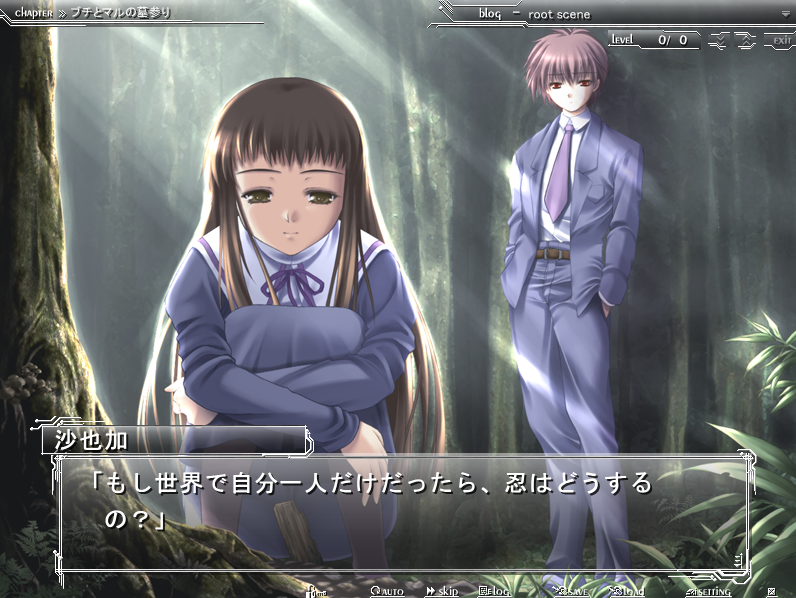
「もし世界で自分一人だけだったら、忍はどうするの?」
“If you were the only person in the world, what would you do, Shinobu?” (Xuse, 2015).
It sounds almost absurd at first. If there truly is nobody left, what exactly are you searching for?
Shinobu's answer is simply that he would keep walking. He would continue searching, even if the possibility of finding anyone was practically nonexistent; for even if the world was impossibly vast compared to the limited distance a single person could travel, he would still move forward.
Now, this isn't optimism. Shinobu never says he expects to find someone. Although, the entire scenario borders on the impossible anyway (well it is a what-if so yea.). One person isn't crossing an empty planet on foot. But that's almost beside the point. Rather, the act of walking itself isn't a means to an end—it is the end. And it is a statement about what kind of person he has decided to be.
「今の回答はね、自己規定をしているだけのものなんだ」
“That answer you just gave is just you defining yourself.” (Xuse, 2015).
I think this is where the two finally diverge. For Shinobu, the self is not necessarily something hidden deep within, waiting to be discovered. It is something that is continually formed through actions. He does not walk because he uncovered some sort of “innate truth” that he is a person who searches. He walks because he has decided that searching is what defines him.
Sayaka, however, starts from almost the opposite assumption. She sees the self as something that already exists, something that can be uncovered by removing everything external. Shinobu defines himself through movement; Sayaka tries to understand herself by stripping things away.
And this is where Shinobu's next statement becomes relevant:
The Shape That Oppression Preserves
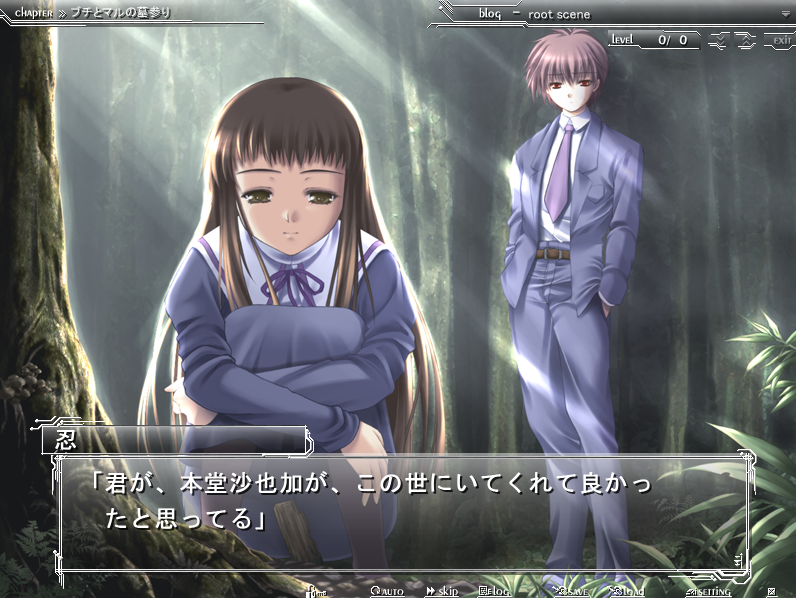
「君が、本堂沙也加が、この世にいてくれて良かったと思ってる」
“I'm glad that you, Honjou Sayaka, exist in this world.” (Xuse, 2015).
What makes this line relevant is not simply that Shinobu accepts Sayaka. It is how he accepts her. He does not say that he is glad someone like Sayaka exists. He does not reduce her into a category, a personality type, or some fascinating exception to ordinary humanity. He names her specifically: Honjou Sayaka.
Not the idea of Sayaka. Not the concept of someone like her. The person herself.
And that distinction matters because Sayaka, for basically the entire conversation, has spent it describing herself almost structurally. She talks about systems, boundaries, and conditions of existence. She understands herself almost like an equation: if certain external factors are removed, then what remains? Shinobu approaches it differently. He doesn't care about preserving some abstract idea of Sayaka. He cares that she exists.
This connects to Shinobu's later discussion of love. He explains that human attraction can technically be reduced to hormones, psychology, and biological mechanisms. Which, on the surface, sounds like a pretty terrible argument for the value of love. “Congratulations, your deepest emotions are chemicals doing their thing” is not exactly the most romantic statement in the world. Yet, Shinobu reaches the opposite conclusion with this:
「ホルモンや心理的錯覚で人を好きになるというのは、皆がそうしていることだけど、口にしてしまうととても虚しいことだ」
“Everyone falls in love through hormones and psychological illusions, but saying it aloud makes it feel terribly hollow.” (Xuse, 2015).「でも反対に、とても自然なことでもある」
“But conversely, it is also something completely natural.” (Xuse, 2015).
The funny thing is that this sounds like it should lead to the opposite conclusion. If love is just hormones, psychology, and biological programming, then surely that makes it less meaningful, right? Except Shinobu argues the opposite. A feeling does not become any less real simply because we understand the mechanism behind it. In fact, part of what makes human experience so fascinating is that we can recognize something as temporary, fragile, and completely explainable, yet still find it deeply meaningful.
Take a sunset: it is still beautiful, even when you understand why light scatters through the atmosphere. A song does not become less moving because you know it is just vibrations and sound waves traveling through the air. The existence of a mechanism does not erase the experience. And this is where Sayaka's problem becomes clearer. Her issue is not that she understands human connection too little. It is almost the opposite, one could say that she understands it too well. She sees the artificiality behind emotions, the irrationality behind attachment, and the instability behind relationships. But because she sees those things, she struggles to accept them as meaningful.
Saihate no Ima doesn't merely discuss this idea abstractly. It actually portrays this process quite literally through Shinobu's perception of Sayaka. Early in her route, there is a scene where the narration explains that years of repeated exposure to Sayaka have created something almost like a dedicated “Sayaka-processing circuit” within Shinobu's mind: 「優先順位を高く設定された反復学習によって、沙也加情報処理回路ともいうべき認識パターンが形成されているためである。」 “Through repeated learning assigned an exceptionally high priority, a recognition pattern—one that could almost be called a ‘Sayaka information-processing circuit’—has been formed.” (Xuse, 2015). Ignoring the fact that this is a very clinical way of describing affection, the narration does not say that Shinobu simply finds Sayaka beautiful, or that he has consciously chosen to pay attention to her. Rather, it describes how his brain has adapted itself to her presence. When Sayaka enters his field of vision, his perception automatically prioritizes her:
「つまり視野に入った光景に沙也加が含まれている場合、忍の脳は細胞活性を著しく高める。より強い認知が行われる―――ついつい目が行く、のである。」
“In other words, whenever Sayaka enters Shinobu’s field of vision, his brain markedly heightens its neural activity. His perception becomes more intense—his eyes are drawn to her before he even realizes it.” (Xuse, 2015).
And more importantly, the narration immediately clarifies that this does not measure the amount of affection he has for her. It is not saying that a higher neurological response equals a deeper love. It is simply describing how Sayaka has become integrated into the way Shinobu perceives the world. Which is quite a fitting way for Saihate no Ima to approach love. It takes something that could very easily be dismissed as “just biology” and shows that biology itself is not some lesser, artificial substitute for meaning. This is, in a way, the almost uncomfortable truth of being human: we are biological creatures. Our memories, attachments, and emotions all exist through physical processes. But that does not make them fake. If anything, it makes them more intimate; that someone can become so significant to another that they literally alter the way they experience reality.
Shinobu's answer is that meaning does not come from discovering something beyond those mechanisms. Meaning comes from choosing to affirm despite knowing exactly how fragile and explainable they are.
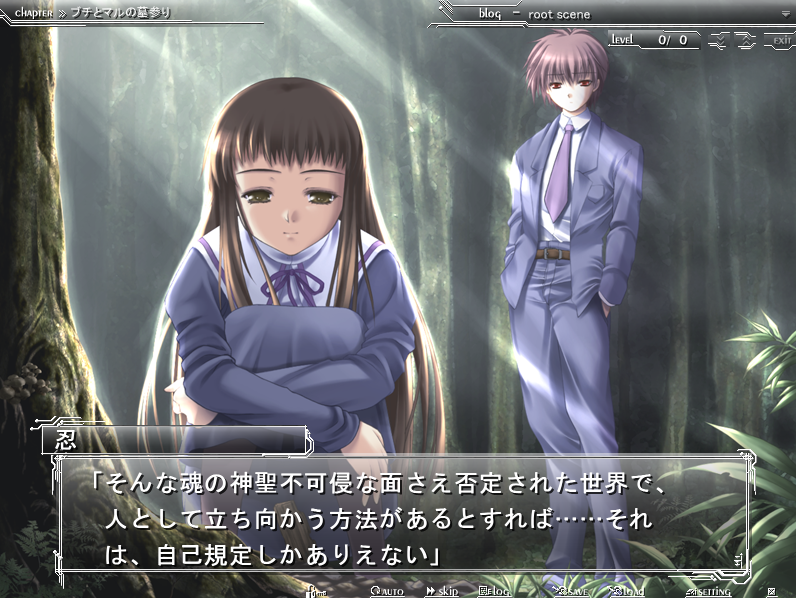
「そんな魂の神聖不可侵な面さえ否定された世界で、人として立ち向かう方法があるとすれば......それは、自己規定しかありえない」
“In a world where even the sacred and inviolable aspects of the soul have been denied, if there is any way for a person to stand against it... it can only be through self-definition [through one's own will].” (Xuse, 2015).
For Shinobu, the self is not preserved by finding some immutable essence hidden inside. It is preserved through the act of choosing what one will become. As concluded earlier, the self is not something uncovered. It is something constructed. But this is precisely what frightens Sayaka. Because if the self can be created through choice, then what happens when there are no limits to those choices?
「もし、私があなたと同様、意志の力で自らを規定をしたとしたら......たまたま内ではなく、外に向かうことを決めたとしたら―――そこは地獄よ」
“If I, like you, were to define myself through the power of my own will... if I had merely happened to choose the outward path instead of the inward one―――that place would be hell.” (Xuse, 2015).
She doesn't fear freedom because she believes freedom is meaningless. She fears it because she believes that freedom without boundaries is indistinguishable from losing herself entirely.
「葛藤は私を抑圧してくれるのよ、忍」
“Conflict is what oppresses me, Shinobu.” (Xuse, 2015).「そして抑圧は私という形を保たせる。果てがやってくるその時まで」
“And that oppression allows me to maintain the shape of myself. Until the moment my end arrives.” (Xuse, 2015).
And this... is the central paradox of Sayaka's character. The things that restrict her are also the things that define her.
Normally, we think of oppression only as something negative (a force that limits, controls, or prevents someone from being free.) But Sayaka sees another side of it. A boundary is restrictive, yes, but restriction is also what gives something its shape. A river is only a river because its banks prevent the water from spreading everywhere. Remove the boundaries completely, and the river does not become more free. It just becomes a flood. Hence, in Sayaka's perspective, absolute freedom is not liberation, it is purely dissolution.
This is why her request to Shinobu is so unusual:
「私に自由を与えないで」
“Don't give me freedom.” (Xuse, 2015).「自由意志は私にとって害毒にしかならない」
“Free will is nothing but a poison to me.” (Xuse, 2015).
Normally, freedom is considered the ultimate expression of individuality. It is what allows a person to choose their own path and define themselves. But Sayaka sees the danger hidden within that idea: freedom without limitation means freedom without form. If everything becomes possible, then nothing prevents the self from expanding beyond recognition.
Of course, neither position is as simple as “freedom good, restriction bad” or the reverse. Shinobu isn't arguing that human connection has no value. Their disagreement is essentially about where the self comes from: whether it is something discovered by removing everything else, or something created through the things we encounter.
Nonetheless, even Sayaka eventually acknowledges the contradiction:
「人は誰もが自由を望むけど、本当に他者や外部からの干渉を一切受けないそれに......耐えられる人間はいないわ」
“Everyone desires freedom, but no human being can truly endure a freedom in which they receive absolutely no interference from others or from the outside world.” (Xuse, 2015).
The self is not preserved by escaping all influence. It is shaped through encounters, through resistance, and through the things that push back against it.
Which brings the conversation back to the elder tree. The tree appeared to represent the perfect existence: something independent, untouched, and capable of standing alone forever.
But Sayaka's realization is that this independence came at the cost of the very things that give a person shape.
A tree can exist alone forever.
But a person cannot become a tree without losing what made them themselves.
Thank you for reading.
References
Xuse. (2015). 最果てのイマ -COMPLETE- ダウンロード版 (Saihate no Ima -COMPLETE- Download Edition) [Windows visual novel]. Xuse.