Warning
The World in Motion
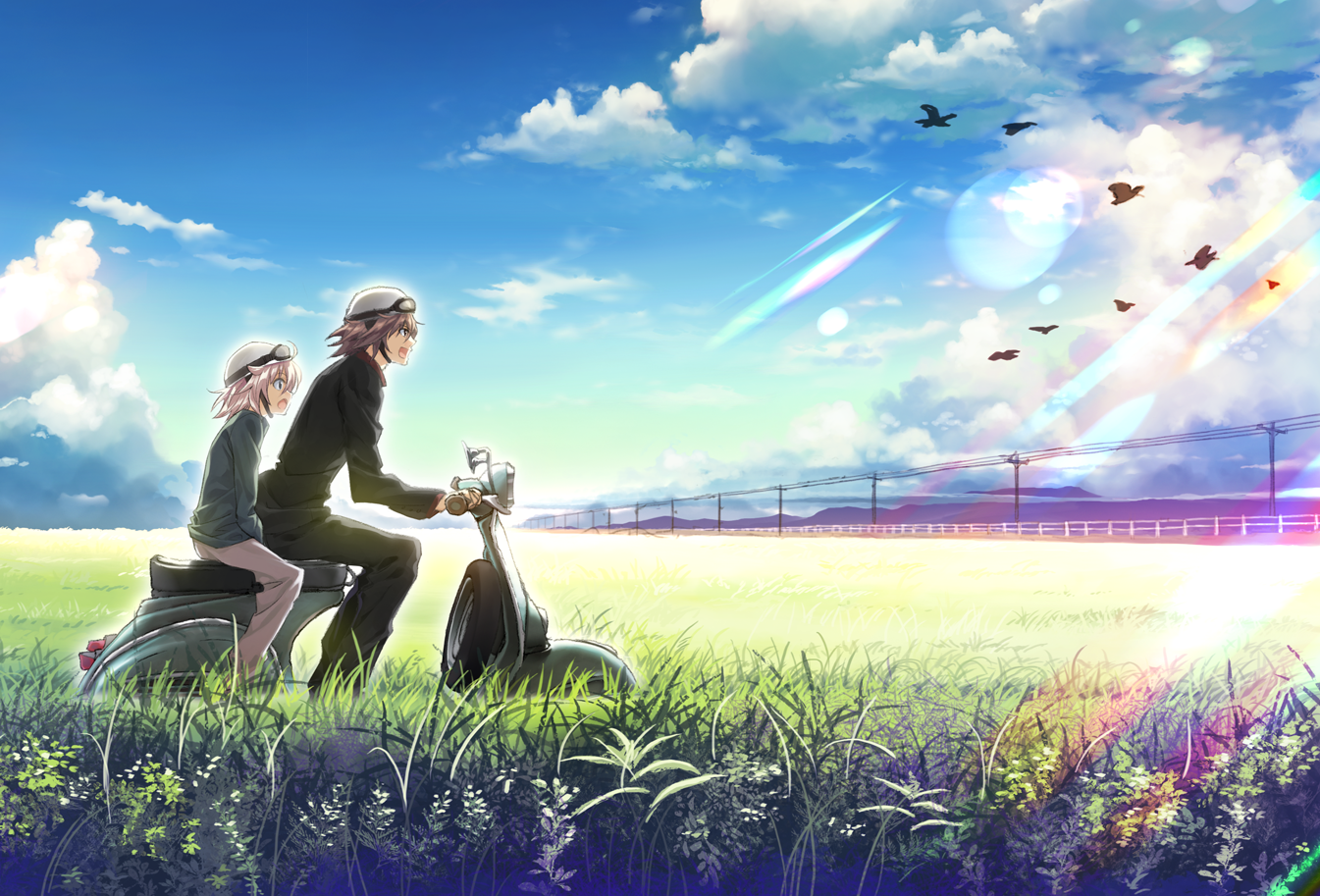
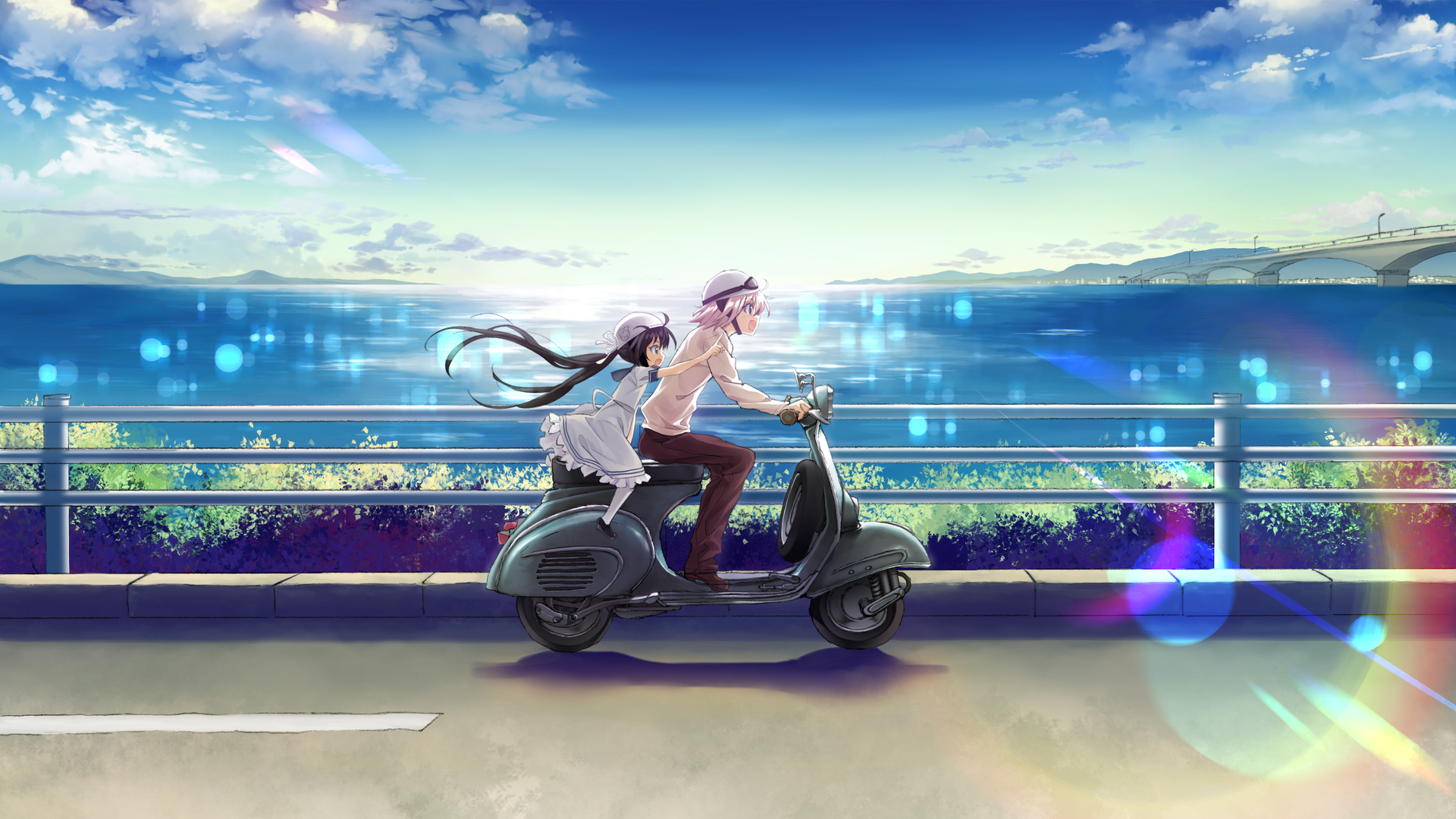
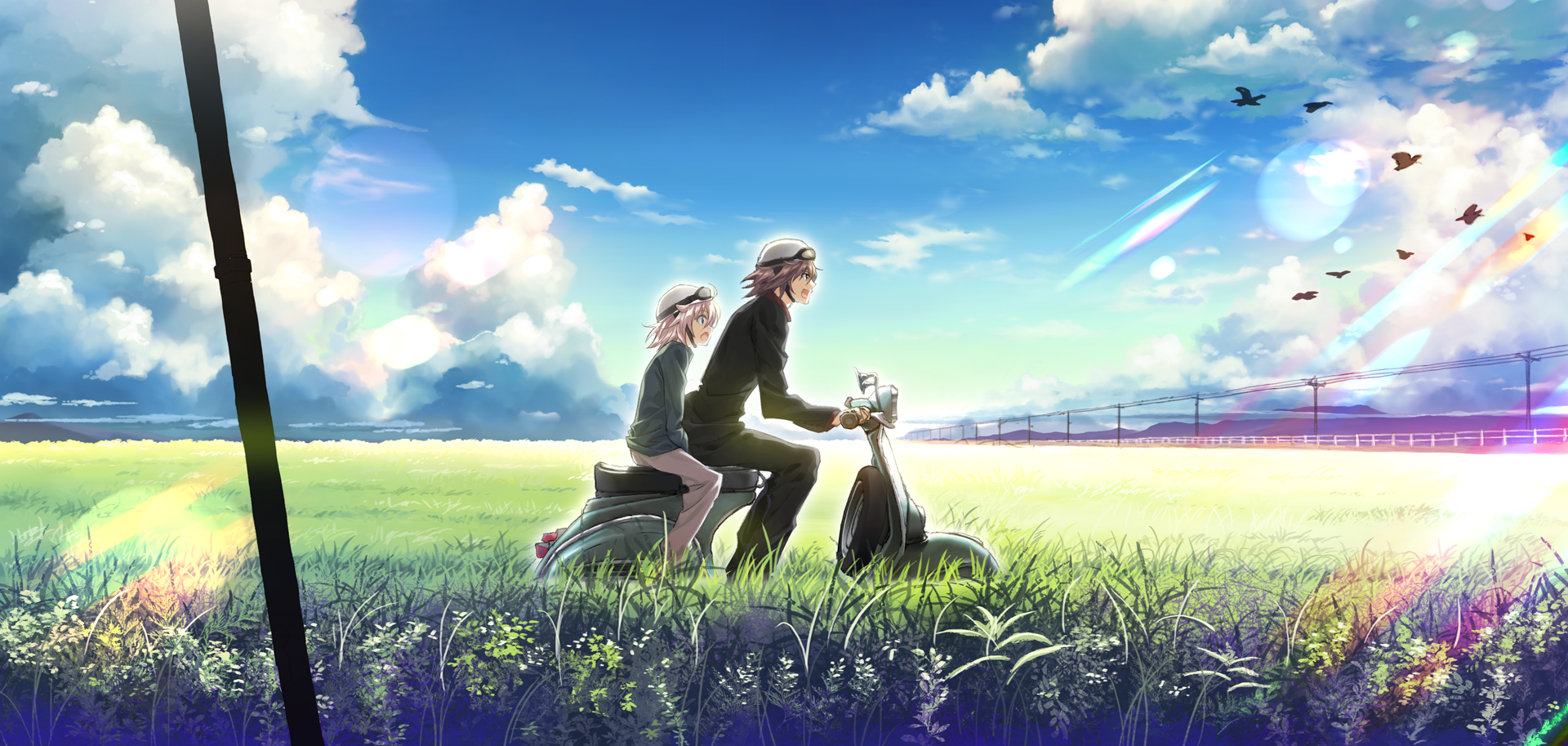
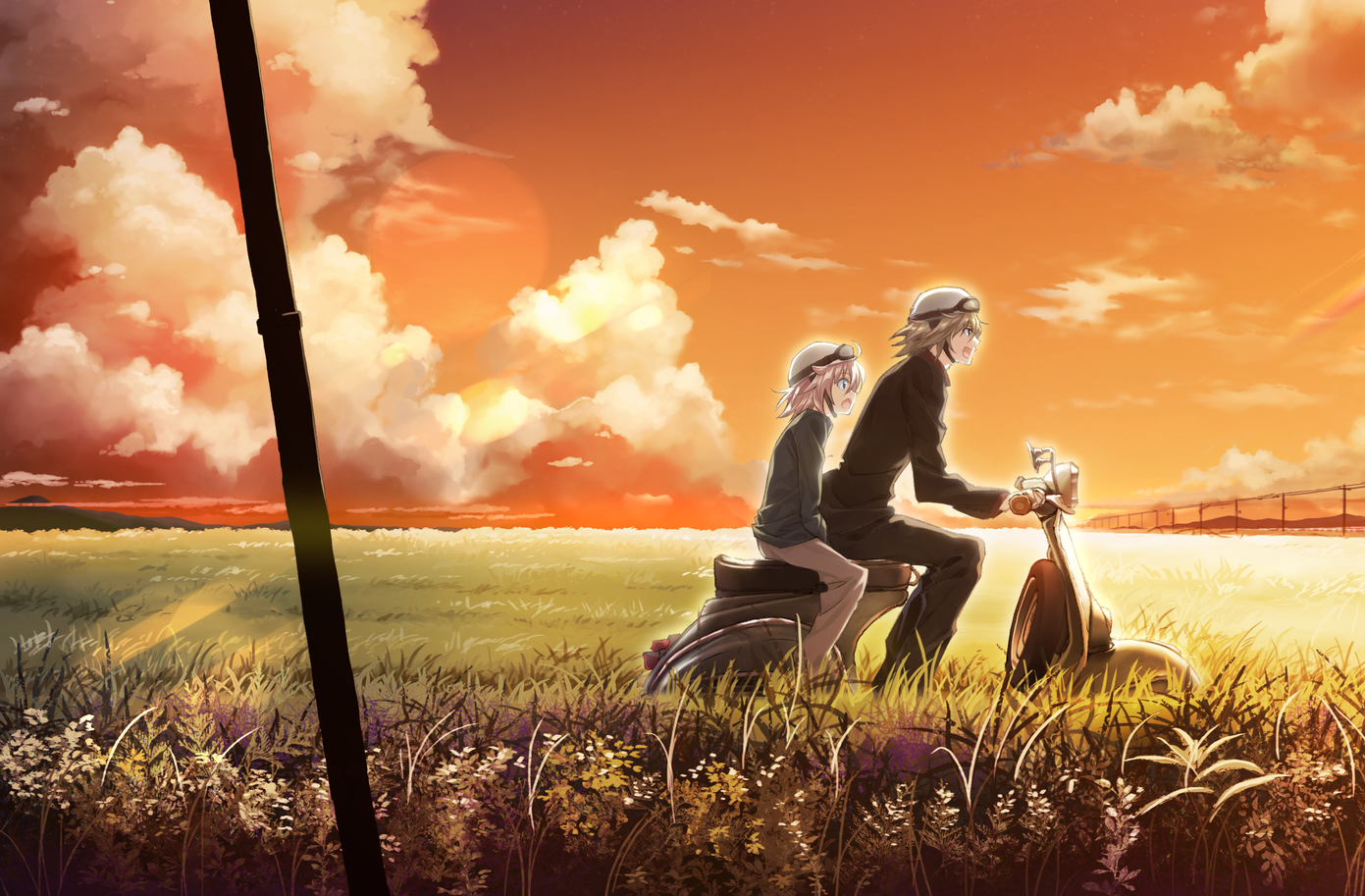
The Vespa ride immediately turns the world into something that is constantly moving. And, as the scenery passes by, the road carries Kei and Ken’ichirou forward, to the point that even the music (the rock music played by Ken’ichirou) disappears almost as soon as it reaches them. The mountains and sea seem to swallow the rock music whole. Ken’ichirou turns the speakers up as loud as possible, yet the landscape remains overwhelmingly silent. The music flows past them just as the scenery does, and Kei begins to recognize that the two are remarkably alike despite belonging to completely different forms of experience: 「流れる景色と流れるロック。それらはとても似通っていながら全然違った。」 (“The flowing scenery and the flowing rock [music]. They were very similar, yet completely different”) (Makura, 2023).
This is where the sequence first introduces its deeper concern with transience: both scenery and music exist through their passage. You cannot hold either still without changing what it is. A guitar note begins disappearing as soon as it is played; a landscape is already giving way to the next as the Vespa moves forward. In that sense, the passage is very close to Henri Bergson’s distinction between conceptualized, spatialized time and lived duration. Basically, Bergson argues that ordinary thought tends to divide reality into discrete, static units, whereas lived time is a sort of indivisible flow in which successive moments penetrate one another: “duration is the continuous progress of the past which gnaws into the future and which swells as it advances” (Bergson, 1998). Kei’s experience of the ride works in much the same way. Each moment becomes part of the next while remaining irreducibly tied to the particular instant in which it was experienced.
This essentially explains why the sequence repeatedly emphasizes the scenery “flowing.” Kei is—while looking at a collection of mountains, towns, and the ocean—experiencing a world unfolding through time. The scenery exists as something encountered now, immediately, before it passes into memory (if you’ve read my other analyses on Sakurano, this is the process of <deranged beauty> turning into <promised beauty>). The music gives this same temporal structure another form. A melody is in and of itself composed of individual sounds, yet its identity depends on their succession; remove the movement between them and the melody itself disappears. The same principle applies to Kei’s perception of the landscape. What matters isn’t merely what is there, but the fact that he is moving through it, feeling the wind and warmth of his body while the world continuously changes around him. The sequence therefore establishes perception itself as temporal, and the present is meaningful because it is experienced before becoming memory.
The Brain and the World
Now, as for the second part of the sequence, Ken’ichirou begins humming a poem by Emily Dickinson, specifically, “The Brain—is wider than the Sky” (Dickinson, 1862):
The Brain—is wider than the Sky—
For—put them side by side—
The one the other will contain
With ease—and you—beside—The Brain is deeper than the sea—
For—hold them—Blue to Blue—
The one the other will absorb—
As sponges—Buckets—do—The Brain is just the weight of God—
For—Heft them—Pound for Pound—
And they will differ—if they do—
As Syllable from Sound—
So, if you’re confused by the series of comparisons that Dickinson makes; that of the brain being wider than the sky, deeper than the sea, and equal in weight to God. If you consider it as a progression, the pattern becomes much more apparent. The sky and sea are immense because they appear to exceed the limits of human perception; then Dickinson reverses that relationship: the mind can contain the seemingly immeasurable world, absorbing it and giving it form. The final comparison then shifts from physical magnitude to an abstract one: the brain and God may differ, “if they do,” only as a “Syllable” differs from a “Sound.” A syllable is a bounded, articulated unit; sound is the broader phenomenon from which such a unit emerges. Dickinson therefore leaves the distinction between “mind” and “world,” or “mind” and “God,” deliberately uncertain. The poem is basically concerned with the peculiar fact that consciousness can contain things that appear infinitely larger than itself, while leaving open the question of what ultimately separates the thing experienced from the form through which it is understood.
Ken’ichirou, naturally, proceeds to explain all of this to Kei in the most Ken’ichirou way possible. His “Rock” interpretation turns Dickinson’s metaphysical comparisons into a joke about an idiot—God—with an “empty” head who can pour the entire sky and sea into it. Although, beneath the absurdity, he has actually made a vital point. If the brain can contain the sky and absorb the sea, then the distinction between inside and outside becomes unstable. This invites a comparison with Merleau-Ponty’s phenomenology, in which he posits that perception does not involve a detached consciousness standing outside an objective world and constructing an internal representation of it; rather, perceiver and world are intertwined through embodied perception (Merleau-Ponty, 1945/2002). Kei does not merely look at the landscape. As I said earlier, he feels the wind, the warmth of his body, the movement of the Vespa, the music, and the scenery passing around him. The world is consequently not simply something he observes, but the environment within which his experience is taking shape.
Ken’ichirou’s command—「そして、今、お前の世界となったものを感じろ!」 (“feel what has become your world, here and now!”) (Makura, 2023)—can thus be read as an almost direct rejection of the Cartesian conception of the subject as an isolated thinking entity. Merleau-Ponty explicitly contrasts consciousness as a Cartesian “I think” (underlying the cogito, ergo sum) with an embodied “I can” (1945/2002), while elsewhere insisting that “I am not in front of my body, I am in my body, or rather I am my body” (1945/2002). In this sense, Kei exists as an embodied being whose identity emerges through his relation to what surrounds him.
A Syllable and a Sound
Kei’s monologue—「その違いは、たぶん音節と音ほどの違いだろう。」 (“The difference between them was probably like the difference between a syllable and a sound ”) (Makura, 2023)—is consequently a sort of philosophical hinge of the conversation. But at this point, I don’t think the line needs to be read as another explanation for what a syllable or sound is. That distinction has already been established. What matters here is what happens when the immediate experience of the world is given some kind of form. Kei has experienced the landscape as something moving, embodied, and inseparable from the particular moment in which he encountered it. Yet the moment itself cannot remain. It passes into memory, where it can be recalled, described, photographed, or eventually painted. This creates the problem of representation. To preface this, it is one of the many places where Sakura no Toki—and Uta—circles around that larger problem. I have explored the problem and its eventual resolution elsewhere, so I do not want to repeat that argument here (see “A Structural Analysis of the Final Painting in Sakura no Toki” if you are interested). I will consequently only briefly follow this thread, focusing instead on what this particular sequence reveals about Kei’s experience of the world.
Plato’s critique of artistic representation in Republic is relevant here because he distinguishes between an object and its representation; essentially, he argues that an imitation is ontologically removed from the thing itself (Plato, 2000). At first, Toki may seem to approach a similar problem: if the lived world is always changing, then any attempt to preserve it risks turning something “alive” into something static. But, Toki does depart from Plato here.
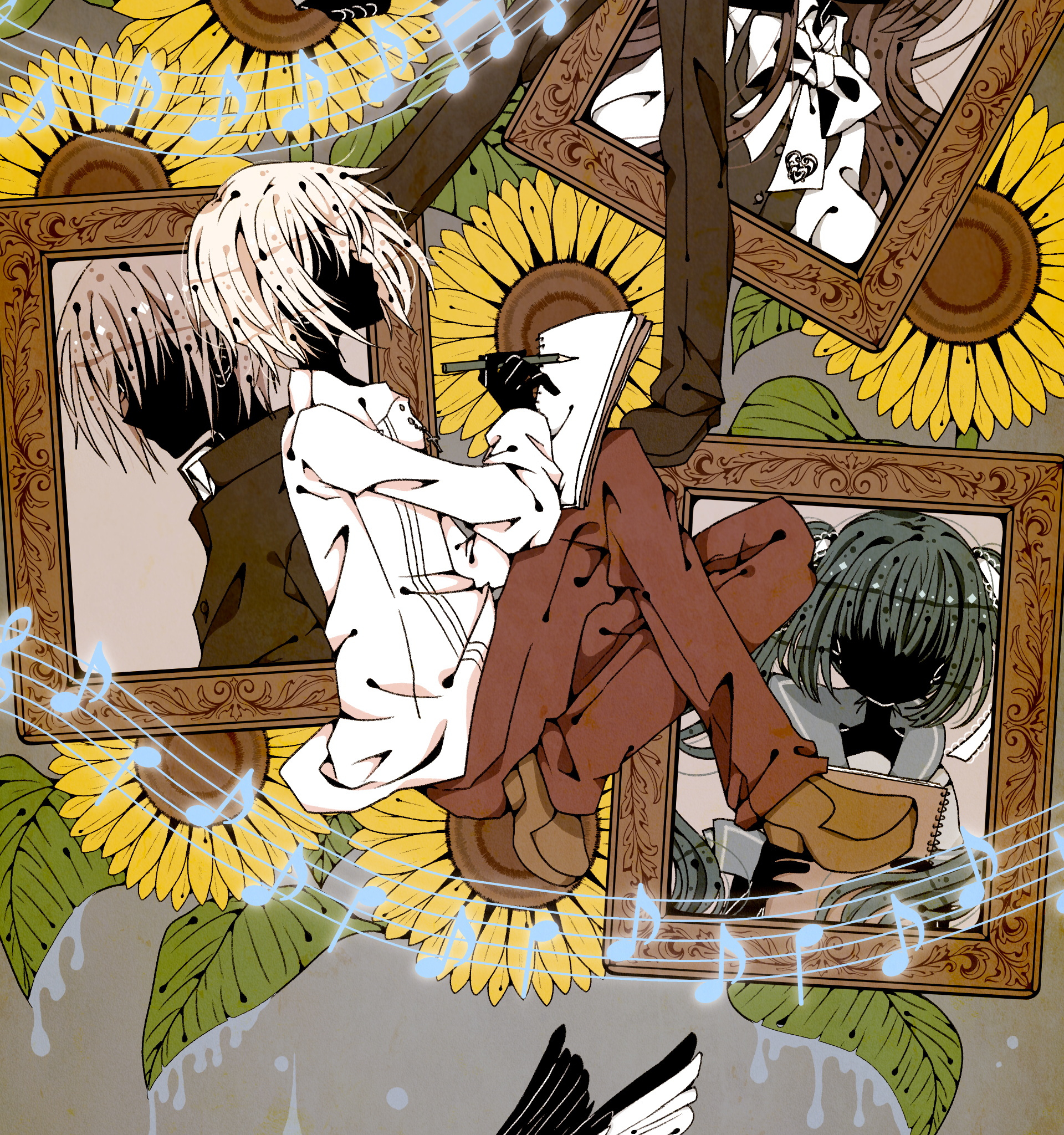
[Toki’s] conception of art does not treat representation as inherently inferior because it is a copy. Rather, the artwork must somehow recover the event-character of what it depicts. Painting must become “rock”: it must not merely depict the butterfly but make the dead butterfly “take flight again.” This becomes especially clear in Ken’ichirou’s metaphor: 「音楽がない絵画など、標本の蝶にすぎない」 (“A painting without music is nothing more than a butterfly in a specimen case”) (Makura, 2023). Visual accuracy alone does not constitute artistic vitality. The specimen remains intact precisely because it is no longer alive; likewise, a photograph can retain the appearance of the past only because the past itself is no longer present.
Ken’ichirou’s demands for “tempo,” “melody,” and “poetry” can be understood as an attempt to overcome this “deadness” of mere preservation. Kei must not create a specimen of the moment; he must create something through which the moment “continues to act.” As seen with another one of Ken’ichirou’s metaphors, 「ギターなんかいらないだろ。俺達に必要なのは六本の弦じゃない。俺達に必要なのはたった一本の筆だ! 一本の筆でかき鳴らすんだよ!」 (“Who needs a guitar? What we need isn’t six strings. What we need is a single brush! You strum it with that one brush!”) (Makura, 2023). The brush becomes more than a tool for depositing pigment onto a static surface; it becomes an instrument through which temporal experience is translated into another medium. To “strum” the brush is to make the painting retain something of the “movement” that produced it. The painting thus becomes an event instead of merely an object.
This also explains why Ken’ichirou insists that Kei remember not just the scenery, but also the wind, the warmth of his body, and the precise “configuration” of himself at that moment. He is effectively telling Kei that the object of art cannot be reduced to external appearance. What must be preserved is the relationship between world and perceiver. If we consider Heidegger’s account of art in The Origin of the Work of Art, where the artwork is not simply a representation of some independently existing thing but a site in which a world is disclosed, then this becomes particularly relevant here. Heidegger writes that “in the work of art, the truth of an entity has set itself to work” (Heidegger, 1971). Hence, a successful artwork does not simply tell us what a thing looks like; it makes a mode of being manifest. Ken’ichirou’s description of 「夏目圭という奇跡」 (“the miracle called Natsume Kei”) (Makura, 2023) can therefore be interpreted as the ability to transform a singular encounter with the world at hand into an artistic disclosure.
Essentially, when Kei paints, its value does not come from accurately copying the scenery, but from allowing the world-as-experienced-by-Kei to become perceptible again, just as we see with his final painting, Two Sunflowers. This is why Ken’ichirou tells him, 「いつもやっているだろ?」 (“You do it all the time, don’t you?”) and 「お前の筆には音楽がある。」 (“There is music in your brush.”) (Makura, 2023). He is not really teaching Kei anything new here; he is simply making explicit what Kei had been doing through his art all along. The “miracle” isn’t some sort of supernatural thing in the conventional sense. Instead, it is the transformation of contingent lived experience into expressive form—the form of painting—without, importantly, annihilating its contingency.
The Miracle Called Natsume Kei
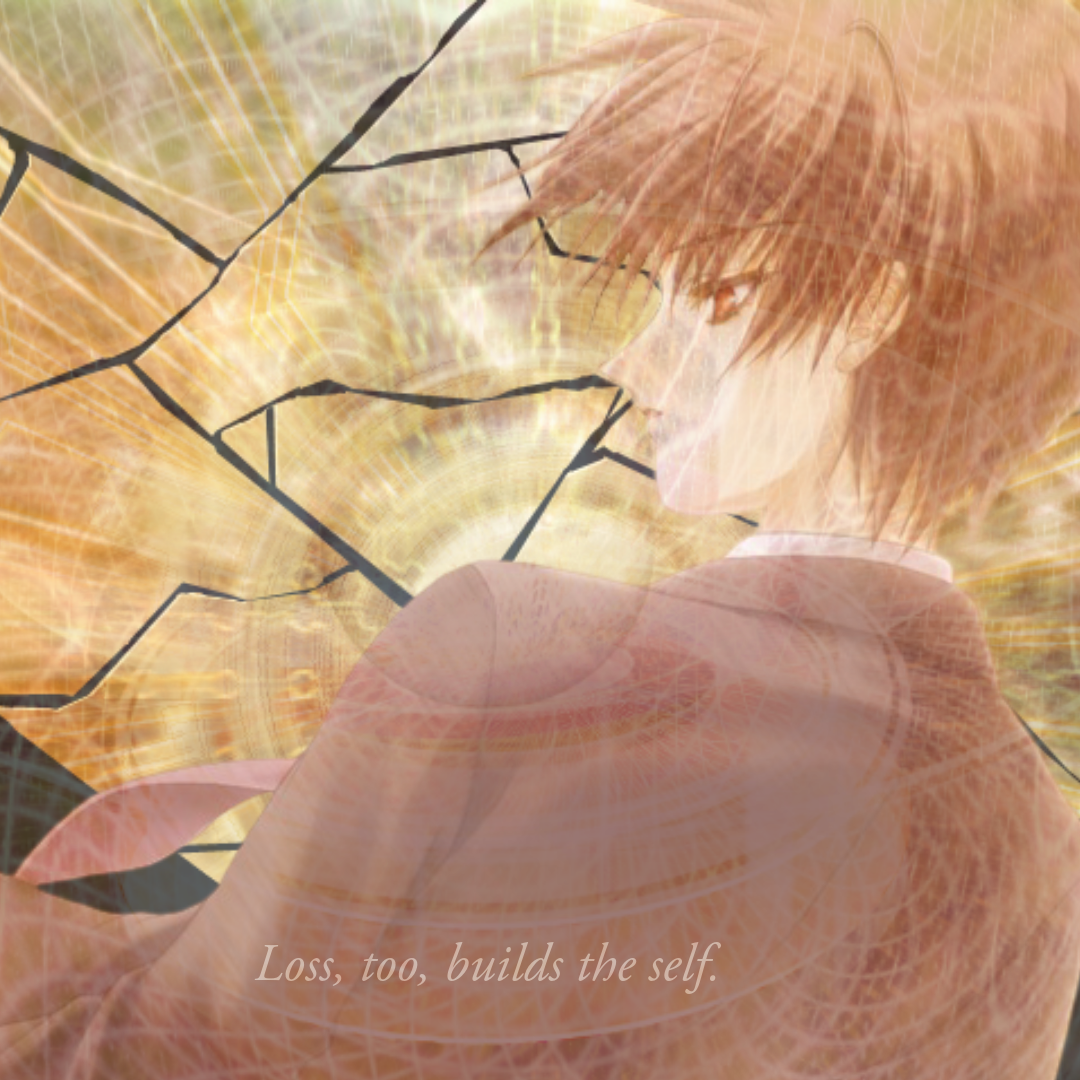
The emphasis on “the you who exists now,” “the you who picked up a brush,” and “the you who finishes that painting” introduces yet another philosophical facet of this sequence; that of personal identity as temporal multiplicity. This is basically a continuation of the earlier conversation Kei and Ken’ichirou had on the “I,” but I digress. Previously, I said that Ken’ichirou tells Kei to remember the world as he experiences it. What matters here is that he also draws attention to the fact that the person experiencing that world is constantly changing. In essence, Ken’ichirou explicitly denies that Kei is one static self persisting unchanged through time: 「今のお前と、筆をとった時のお前は違う」 (“The you who exists now is different from the you who picked up a brush.”) and 「そして、その絵画を描き上げたお前もまた違う」 (“And the you who finishes that painting will be different again”) (Makura, 2023). The experiencing Kei, the painting Kei, and the Kei who eventually completes the work are therefore temporally distinct. But Ken’ichirou doesn’t conclude that Kei lacks identity. Instead, the fact that all of these different “selves” belong to one unfolding trajectory is exactly where the miracle lies: the miracle called Natsume Kei.
This is closely related to philosophical theories of the self that reject a simple, immutable substance underlying experience. David Hume, for example, proposes that when he looks “inward,” he never encounters a simple, permanent self, but instead finds “a bundle or collection of different perceptions succeeding one another with inconceivable rapidity [...] in a perpetual flux and movement” (Hume, 1739–1740/2000). The passage’s formulation is more affirmative than Hume’s skepticism, however.
And, as said, the multiplicity of Kei is not a defect to overcome. It is precisely what makes Kei’s existence miraculous. The self is not miraculous because it remains identical; it is miraculous because it changes while retaining enough continuity to recognize its own transformation. This is also why the temporal structure of the scene matters, insofar as it reflects this process of change. The scenery changes, Kei changes, and yet memory creates a thread between those moments. Identity is therefore posited as a sort of “artistic composition” rather than an immutable object: different moments are themselves distinct, but their relation produces something that can meaningfully be called “Natsume Kei.”
Strumming the World
草薙健一郎の言葉は難しい。けど、それでも、俺には健一郎の言うことが瞬時に分かった気がした。だから俺は大声で叫んだ。
Kusanagi Ken’ichirou’s words were difficult. And yet, somehow, I felt that I understood what he meant immediately. So I shouted at the top of my lungs.「あります! 俺の筆と絵の具には、ロックな詩が詰まってます!」
“They do! My brush and paints are packed full of rock-and-roll poetry!”「いい答えだ! お前の筆はロックだ! ディキンソンだって裸足で逃げ出すくらいに、お前の絵画はガンガンに鳴り響くロックだ! だから奏でろ!」
“Now that’s an answer! Your brush is rock! Your paintings are rock blasting at full volume—so loud that even Dickinson would run away barefoot! So play it!”「あらゆる、今、という奇跡を! 世界の奇跡! 今という奇跡! お前という奇跡! だが、すぐに人はその奇跡を見失う。存在の奇跡を忘れる。だからかき鳴らせ! 世界の果てに届くほど。ガンガンにかき鳴らした音楽で、この奇跡を刻みつけるんだ! あらゆる世界に! あらゆる事実に! あらゆる心に!世界の奇跡をかき鳴らせ!」
“Play every miracle of this moment! The miracle of the world! The miracle of now! The miracle of you! But people quickly lose sight of those miracles. They forget the miracle of existence. So strum it! Strum it loud enough to reach the ends of the world! With music blasting at full volume, carve this miracle into the world! Into every world! Into every fact! Into every heart! Strum the miracle of the world!”
What Ken’ichirou ultimately asks Kei to do, therefore, is not just to paint the landscape he has seen. He asks him to strum the world. This metaphor brings together almost every distinction which has been established through the conversation they had: scenery and music, world and consciousness, experience and representation, present and memory, and the different versions of Kei that exist across time. In its literal sense, to strum something is to make it vibrate, to set it into resonance through an act of expression. But Ken’ichirou’s choice of 「かき鳴らせ」 (“strum it!”) (Makura, 2023) makes the order more forceful than that: Kei is being told to make the world ring out, to give the fleeting miracle of existence an expressive form powerful enough to reverberate beyond the moment in which it was experienced. The point is not to freeze the miracle of existence into a permanent image, but to make it resonate—to turn that movement of lived experience into something that can continue to move through every world, every fact, and every heart.
(And, as a sort of continuation of my final painting argument, that is what Two Sunflowers eventually does for Naoya: it takes the density of Kei’s lived experience, concentrated into a single work, and allows it to continue resonating within another consciousness, even long after the original moment has passed.)
Thank you for reading.
References
Bergson, H. (1998). Creative evolution (A. Mitchell, Trans.). Dover Publications. (Original work published 1907).
Dickinson, E. (1862). The brain—is wider than the sky.
Heidegger, M. (1971). The Origin of the Work of Art. In A. Hofstadter (Trans.), Poetry, Language, Thought. New York, NY: Harper & Row.
Hume, D. (2000). A treatise of human nature (D. F. Norton & M. J. Norton, Eds.). Oxford University Press. (Original work published 1739–1740).
Makura. (2023). サクラノ刻-櫻の森の下を歩む- 通常版 (Sakura no Toki: Sakura no Mori no Shita o Ayumu — Regular Edition) [Windows visual novel]. Makura.
Merleau-Ponty, M. (2002). Phenomenology of perception (C. Smith, Trans.). Routledge. (Original work published 1945).
Plato. (2000). The Republic (G. R. F. Ferrari, Ed.; T. Griffith, Trans.). Cambridge University Press. (Original work published c. 375 BCE).
Thank you for reading.