In one corner of the schoolyard stood a rabbit hutch.
It was little more than a shoddily built shack; no one could honestly call it a comfortable place to live. Yet, whether they wished it or not, the rabbits lived there.
They had no choice.
Human beings are no different. We appear to choose, yet in the end life yields only a single outcome.
Once the conditions are fixed, life becomes a single path. In that sense, it can be said to have already been decided.
Atemiya Shinobu found no particular value in free will.
He did not scorn it, but neither did he believe it possessed any special merit.
The road to the left and the road to the right were equal.
Freedom and restraint were of equal worth.
Solitude and companionship were no different.
So long as one does not impose one's own subjectivity upon things, there is no suffering.
To be governed by something is only natural, and not merely in the case of fate.
No individual stands equal to the universe itself—
Everything that exists as a part of something else necessarily occupies a subordinate place.
We are directed by external pressures, ethics, rules, fate, and duty.
And that which directs us is, more often than not, an enemy.
The proclamation that humanity must be free rings loudly.
Yet when certain people desire the security of being governed, exercising their freedom by surrendering freedom itself, it begins to resemble the punchline to a bad joke.
Even so, that too is undeniably a form of freedom.
Modernity is the expansion of individual consciousness.
And the ethics by which the world is divided remain fundamentally constant.
The round cake called the world appears, at first glance, to be sliced evenly and distributed fairly.
Yet the freedom people seek under the name of “rights” conceals an infinite appetite.
One slice of cake is never enough.
And so that desire can only sink ever deeper into the self.
People have rights.
And they march beneath the banner called responsibility.
They have the right to act recklessly.
They have the right to travel abroad and become mercenaries.
Modern society may one day recognize the freedom to choose euthanasia.
It may even come to recognize suicide itself as a matter of freedom.
This inward descent can give rise to lives sealed away in private rooms.
It tolls the evening bell, proclaiming that trespassing into another person's heart is a sin.
Yes—
Modernity, having lost the brilliance of its age of rapid growth, has become synonymous with twilight.
Each person's heart is gradually transformed into a sanctuary.
And yet, to be alone is lonely.
One must cast a message outward.
If possible, one wishes to wield a consciousness so densely condensed that it strikes others—leaving an impact, changing them.
Media of transmission—
The network provided precisely the environment for that.
But then... was the very notion that networks could unite humanity ever anything more than an illusion?(Xuse, 2015).
Too Late for the Earth, Too Early for the Stars
There is something slightly off about the way we seek connection nowadays. Or perhaps “contradictory” is the more accurate word. We live in an age where almost any thought can be transmitted instantly, where the distance between people has been reduced to little more than a few seconds of typing. Yet, despite being surrounded by constant communication, there remains something fundamentally solitary about existing as an individual consciousness. How is it that we have become capable of reaching almost anyone, while still struggling to truly reach one another?
There is a familiar saying that humanity was born too late to explore the Earth, too early to explore the stars, and just in time to experience the internet. Obviously, it is little more than an internet joke, but perhaps it unintentionally captures something about the modern condition that Saihate no Ima is concerned with. Humanity's gaze has continually expanded outward: from the land beneath our feet, to the oceans, to the heavens, and eventually toward the unknown beyond them. Expansion itself became a symbol of progress. Yet this expansion has also created a distance between the scale of humanity and the scale of the individual. The world has become something far larger than any one person can meaningfully experience. Perhaps, when faced with something so vast, what we seek is not an infinite world, but a small place within it that can still feel like our own. A sanctuary.
That contradiction is what makes these two passages from Saihate no Ima particularly interesting. The first, from Youko's route, begins with a discussion of free will, but I do not think its real concern is whether humans are truly free. Rather, it is concerned with what happens when the individual becomes the center of everything. Modernity expands consciousness, turning each person into a private world of their own. The heart becomes a sanctuary, something sacred and beyond the reach of others. But a sanctuary, by nature, is also a place separated from the outside. The more absolute that separation becomes, the more difficult it is for anyone else to truly enter. And this begs the question: if every person becomes their own private world, then how much of that world can ever truly be shared with someone else?
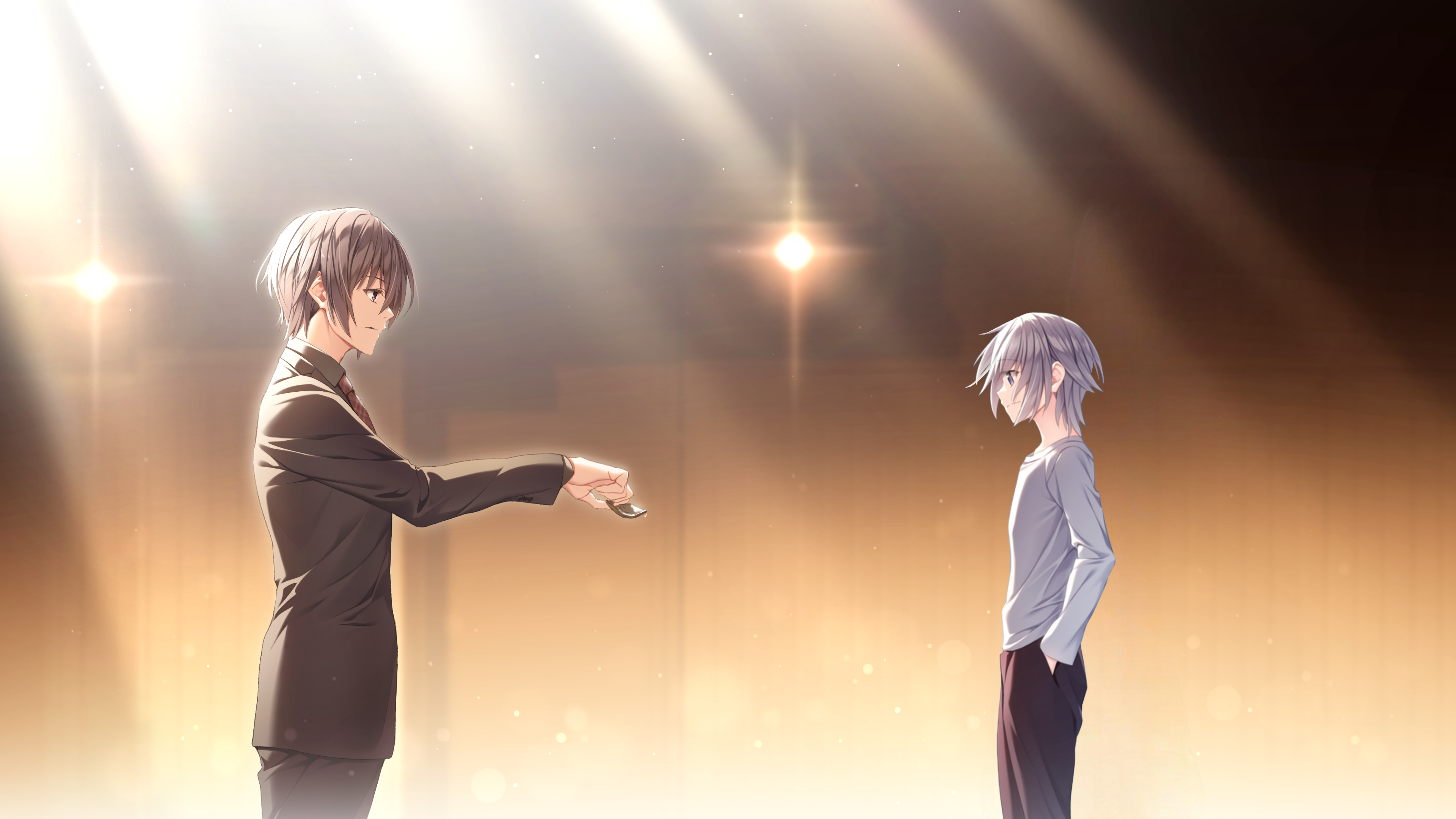
This idea also appears much earlier in Azusa's route, where Shinobu's room is described as a reflection of his inner world. At first, it is nothing more than a functional space, a place reduced entirely to necessity. Then the narration describes it as “a sanctuary dwelling within ruins.” The interesting facet of this line is that this sanctuary is not defined by isolation. Shinobu doesn't simply desire a place where he can disappear from the world. He wants a place where companions can gather, sheltered from everything beyond it. A small community. For Shinobu and the others, this small space becomes almost the entirety of the world.
As always, once the medicine has been taken, there remains nothing to do.
There is nothing in the room with which to pass the time.
A space that can truly be called private has been distilled into forgotten relics.
A room meant only for sleep—for laying one's body to rest.
A room reflects the one who inhabits it.
The state of a room is nothing less than the landscape of the mind itself.
Once, Shinobu's inner world consisted of function alone.
But not anymore.
At least, it should not.
A sanctuary dwelling within ruins.
Could that not, indeed, be called Shinobu's heart?
It does not require much.
Only that they are there—
That companions may gather in one place, sheltered from the world beyond.
A small community.
For Shinobu and the others, it is almost the entirety of the world.
The world is immeasurably vast; no single being can ever perceive it in its entirety.
Humanity evolved, and with it expanded its world.
Its gaze turned outward, and boundless expansion came to be regarded as a virtue.
“Be fruitful, and fill the earth.”
So, it is written, did God command the children of man.
Fill the earth—then the seas, the heavens, and beyond the heavens, without end.
Yet expansion carried to its utmost limit is but another name for ruin.
Thus, expansion itself cannot be affirmed without reservation.
For the world is finite.
Somewhere, a compromise must inevitably be reached.
Just as human civilization itself eventually stagnated.
To begin with, the bounds of individual perception are narrower still.
To any one person, the ever-expanding dominion of humanity has all but lost its meaning.
It is enough simply to have a place to belong.
Perhaps that is why decline began.
In the end, all that awaits is the partitioning of the sanctuary into solitary rooms.
For the only place perfectly aligned with each person's ego—the only place where one may feel entirely at ease—exists within the heart alone.(Xuse, 2015).
Taken together, these two passages do seem to revolve around a similar contradiction. The sanctuary exists because the world has become too vast for any one person to fully experience, yet the same walls that provide shelter can also separate us from others. In Shinobu's case, the sanctuary wasn't born from a desire to reject the outside world, but from the desire to preserve a place where connection remains possible. The tragedy is how easily that sanctuary can turn inward, becoming a shelter that protects the self while closing itself off from others.
The sanctuaries we build around ourselves can also become walls. We want privacy, but we also want to be understood. We want a world that feels as though it belongs entirely to us, but we still hope someone else will find their way inside. Perhaps that is why the network becomes such a fitting symbol for modern life. It offers the ability to project ourselves outward, to send messages from one “sanctuary” to another. Humanity learned how to connect the entire world before it learned how to truly enter another person's heart. But does that truly overcome the distance between us? Or does it merely give us new ways to remain alone together?
Thank you for reading.
References
Xuse. (2015). 最果てのイマ -COMPLETE- ダウンロード版 (Saihate no Ima -COMPLETE- Download Edition) [Windows visual novel]. Xuse.