Note
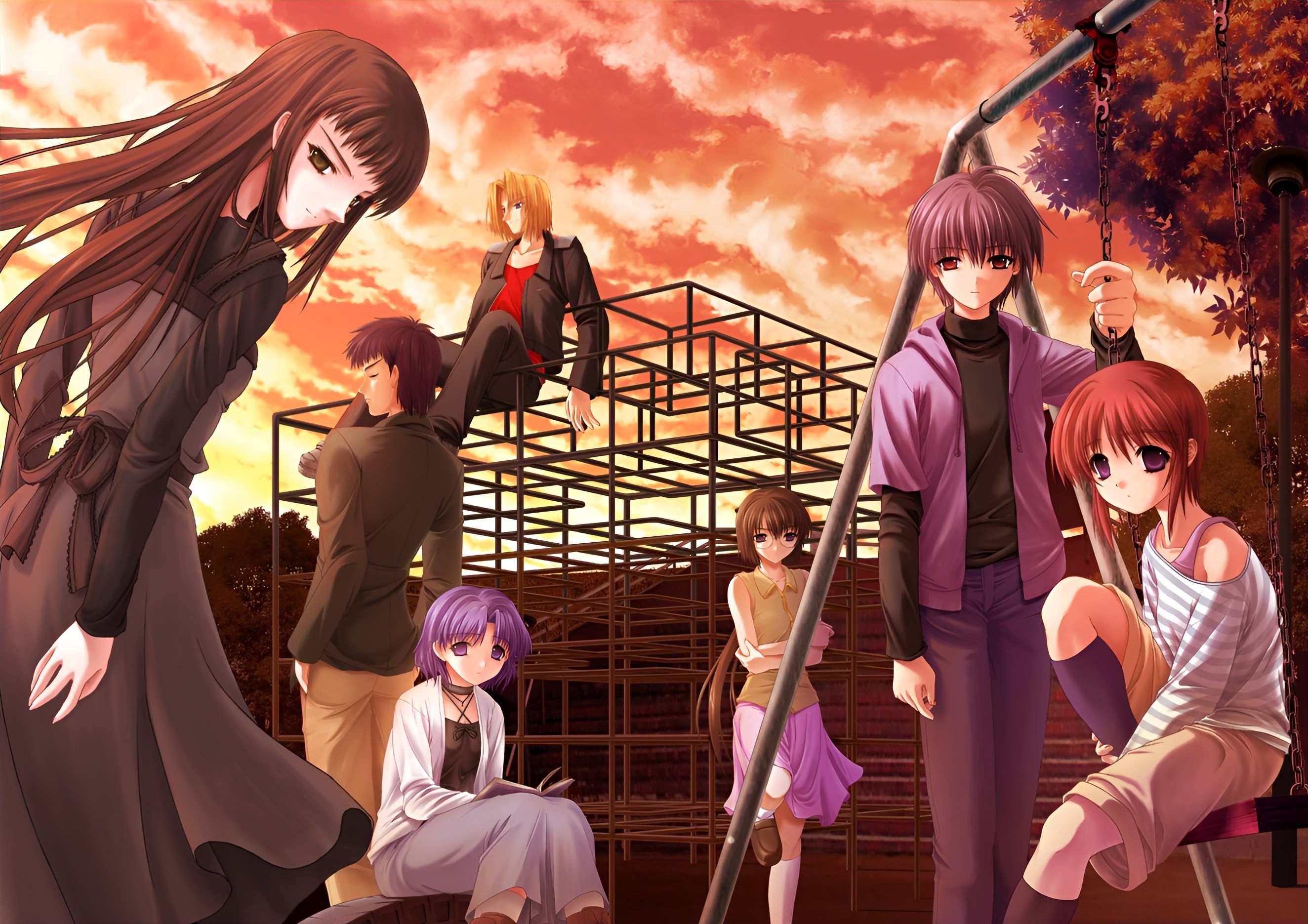
They were always seven.
Cherishing even the smallest scraps of time, they would gather at an abandoned factory on the outskirts of town.
A forgotten rectangular structure, carrying rust and dust within its womb.
Though barren and unadorned, it possessed a certain charm.
The traces of human life that had once filled it had long since dried away,
leaving behind a faint melancholy that lingered in the air.
As though inviting one to reflect upon its former glory...
it could strike a chord deep within the heart of whoever beheld it.
The young people, however, saw it differently.
To them, this forgotten world was a territory without an owner.
The young inherit what has grown old.
Following that principle—
the principle the world has repeated without end throughout its history—
they found a place to gather.
A place of rest that was neither home nor society.
A place someone once called a “sanctuary.”
The world is filled with falsehood, and betrayal.
People wound one another.
No matter how intimate the bond, conflict cannot be avoided.
And yet—
even if contact between people means wounding one another,
that very pain is proof that the other person truly exists.
And that is precisely why bonds between living, flesh-and-blood people
become something irreplaceable...
Puzzle pieces scattered into a thousand fragments.
May they, somehow,
be arranged with gentle hands———(Xuse, 2015)
This paragraph is the opening to the visual novel 『最果てのイマ』 (Saihate no Ima), originally released in 2005 as an 18+ adult PC game by Xuse under their ザウス【純米】 label, with the scenario written by Tanaka Romeo. The title itself is somewhat difficult to translate directly; though it can be rendered as something like “Ima at the Farthest End,” or more simply as “Farthest,” though perhaps the most interpretive reading would be “The Farthest End of the Heart.” If you've been around the visual novel niche long enough, you might have heard of Tanaka Romeo through his other works, such as 『終のステラ』 (Tsui no Stella), 『加奈~いもうと~』 (Kana ~Imouto~), 『家族計画』 (Kazoku Keikaku), 『Rewrite』, or his most well-known work, 『CROSS†CHANNEL』.
Regardless, Saihate no Ima is, well, quite the visual novel if I were to describe it.
A Somewhat Deranged Introduction.
With its endless digressions, and then further still—digressions within digressions—it is not really a story I could recommend to anyone honestly. Like, it borderline gatekeeps itself through its structure alone. But that does not in any way mean it is a bad story. If anything, it is undeniably a masterpiece. Looking at the opening paragraph alone, the story asks us to arrange the puzzle pieces scattered into a thousand fragments: 「優しく、配列されますように―――」. And I cannot really think of any other apt description for this visual novel.
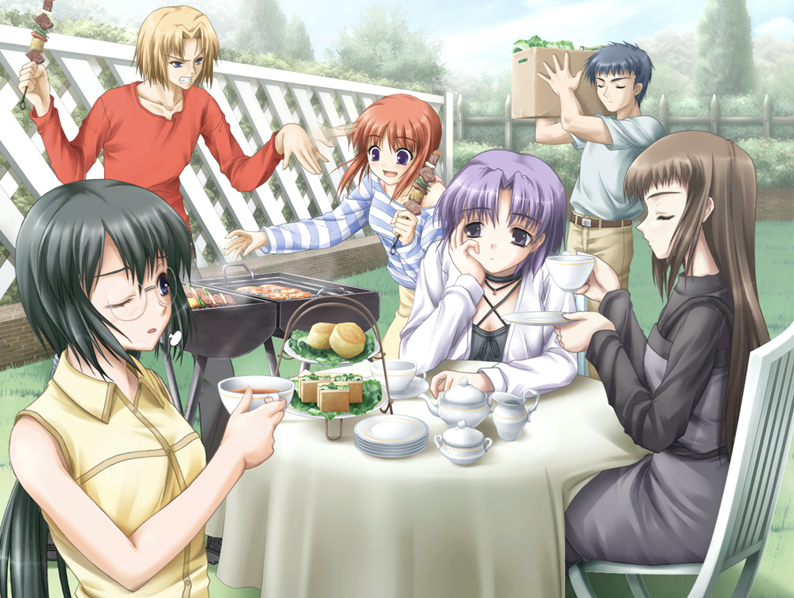
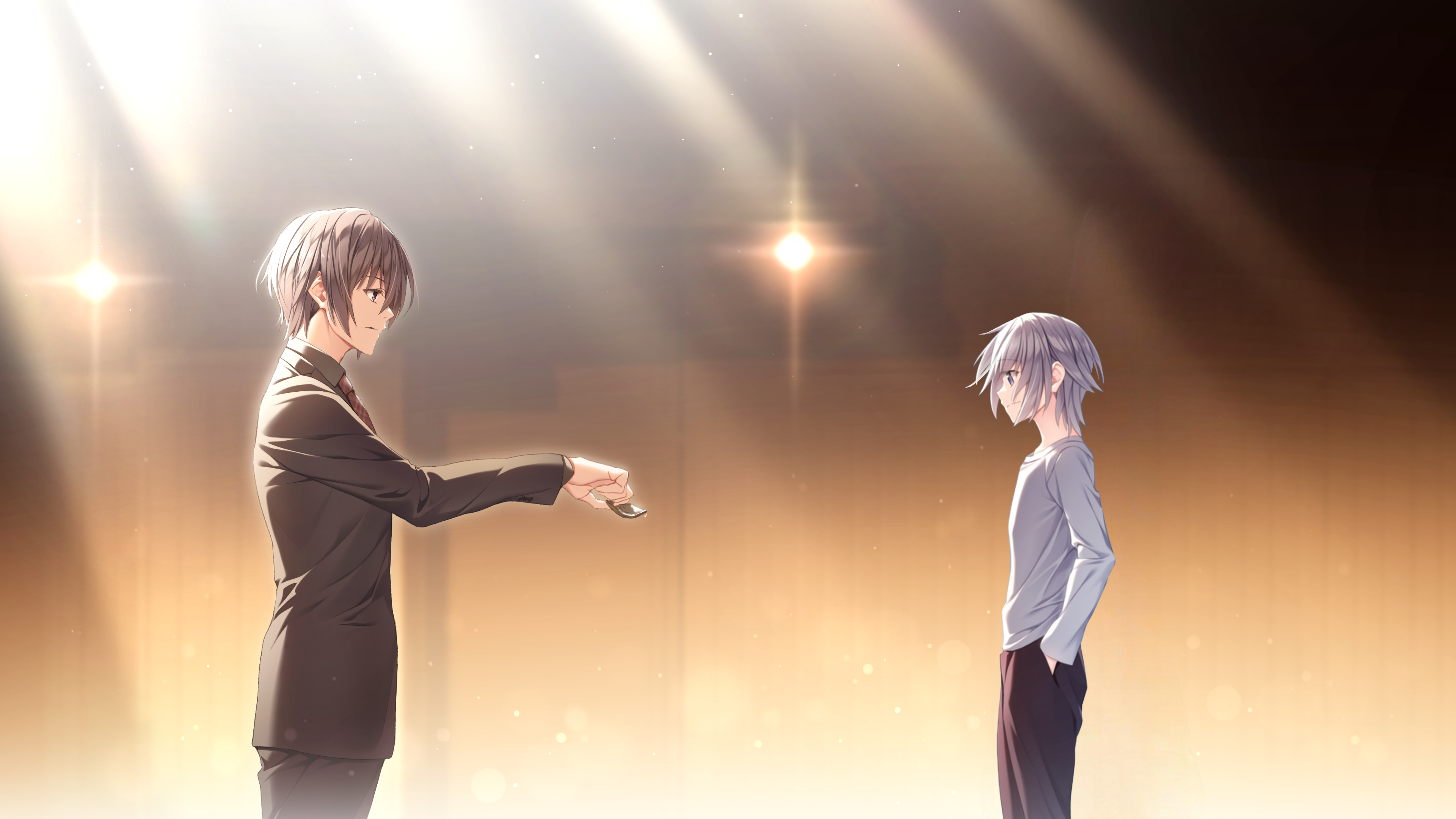
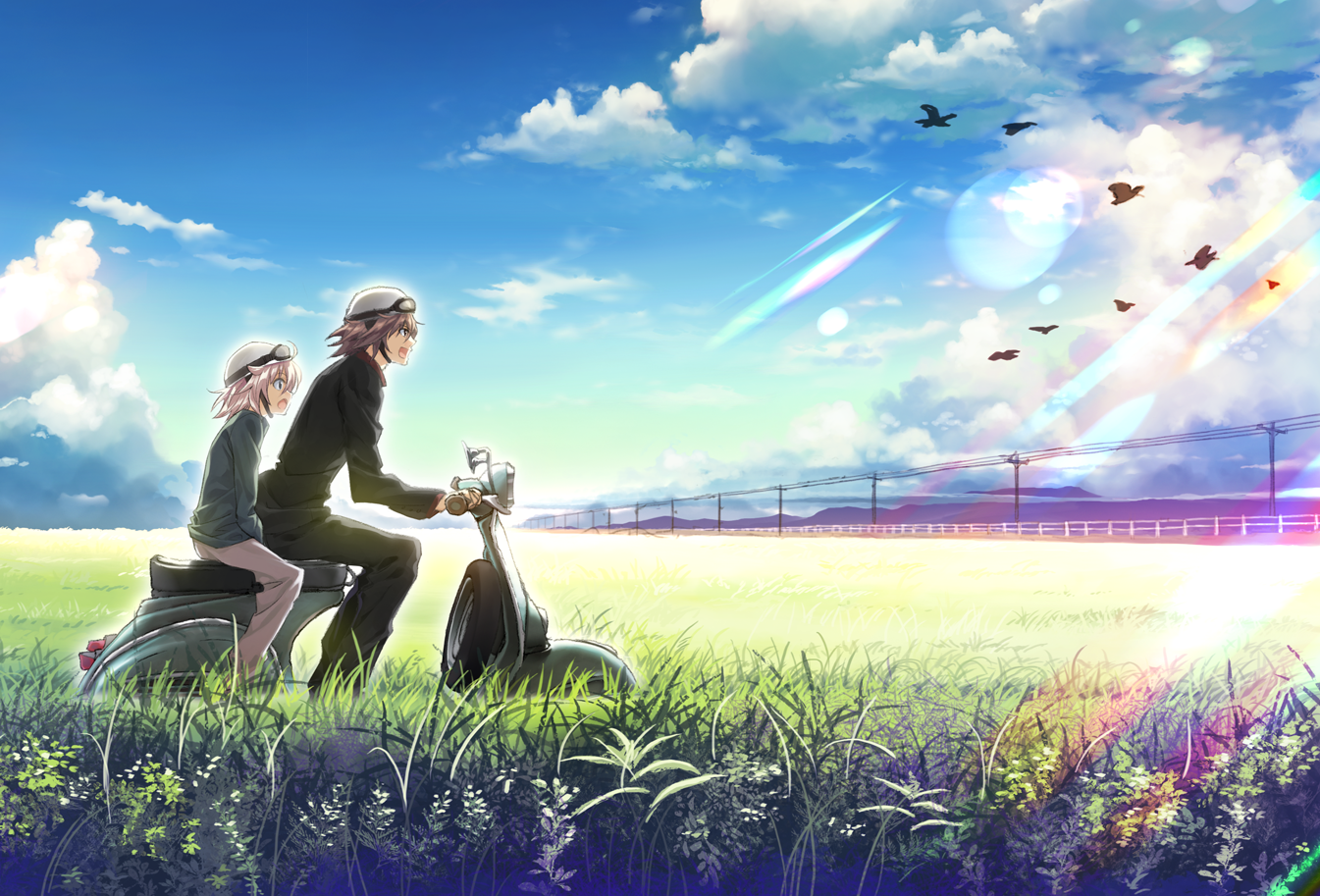
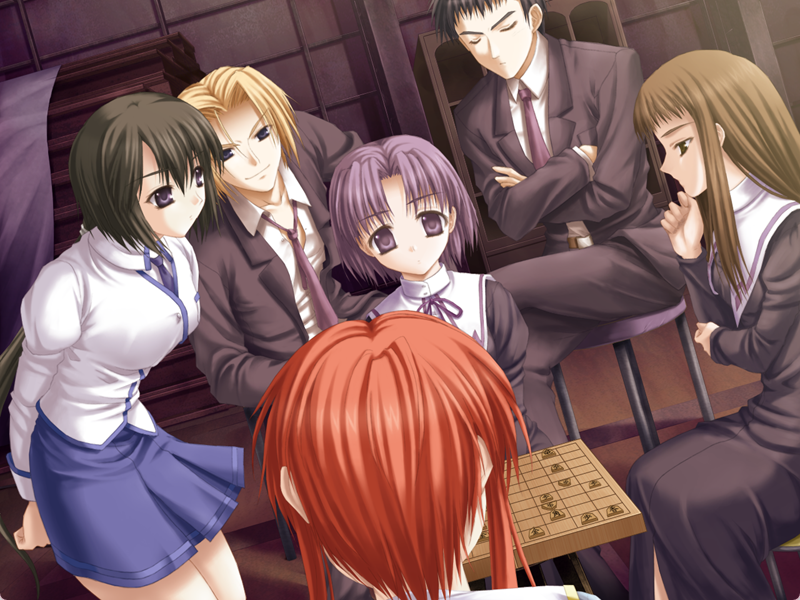
At its core, Saihate no Ima is a story about seven friends. The protagonist, Atemiya Shinobu, spent much of his early life isolated within a certain facility, never having anyone he could truly call a friend. After leaving with his sister Chidori, his first desire is a simple one: to find people he can connect with. So, through this, he eventually meets six others—Azusa, Sayaka, Youko, Itsuki, Shouji, and Fueko—and together they form a group of seven. They gather at an abandoned factory on the outskirts of their town, a place seperate from both home and society, a place they eventually come to call their sanctuary (聖域).
On the surface, it is a story about the fleeting happiness of adolescence: the bonds formed between people who were once alone, the understanding they find in one another, and the conflicts that inevitably arise as they grow closer. It is about the fragile nature of human connection, and the desire to preserve something that feels like it should last forever. Nevertheless, regardless of how you feel about it, time, by its very nature, does not allow such things to remain untouched.
時間は目に見えない。
変わりないようでいて、瞬間ごとに移ろっていく。
気がつけば、変わりないはずの今は、過去となる。“Time cannot be seen.
Though it appears unchanged, it shifts with every passing moment.
Before one realizes it, the present that should have remained the same has already become the past.”(Xuse, 2015)
But, as the opening already hints at, Saihate no Ima is not really interested in telling this story in a straightforward manner at all. The memories of these seven people, their relationships, and the world surrounding them do not exist as one linear thread, where the past simply serves as backstory to the present like you might be used to in other stories. Instead, they are scattered across countless fragments, leaving the reader to slowly piece together what was lost, what changed, and what remains.
You are thrust into a seemingly incoherent and fragmented story, moving from scene to scene, from unrelated topics to completely different ones, with only the faintest lingering trace of what could be called an Ariadne's thread guiding you through it all. At the same time, I do not think the difficulty of Saihate no Ima comes from any individual scene being impossible to understand. More often than not, a scene is perfectly comprehensible on its own. You can follow the conversation, understand what the characters are discussing, and appreciate whatever strange tangent Romeo has decided to take you through. The real difficulty emerges when you try to take a step back and ask: where exactly am I?

The story constantly shifts between different points in time, different perspectives, and different fragments of information without always making it immediately apparent how they connect. A scene can end, and the next can feel as though it belongs to an entirely different story. A conversation about something mundane can suddenly lead into a memory, a document, a philosophical discussion, or some obscure piece of knowledge that seems completely unrelated to anything before it. Then, after spending what feels like an eternity somewhere else, you are suddenly returned to the original thread, expected to remember where you were, what was happening, and how you even arrived there in the first place. And this is where the difficulty begins: when you try to take a step back and look at the larger shape of the story.
Where exactly are we? When is this even happening? How does this connect to the scene that came before it, or the scene that comes after? Saihate no Ima constantly presents you with pieces of a puzzle, but rarely actually tells you which those puzzle pieces belong to.
For instance, a character can spend one scene doing something completely ordinary, only for the next to reveal a completely different emotional state, some unresolved memory, or some event that seems to have occurred somewhere outside your understanding. Then, before you have even had the chance to reconcile those two pieces together, the story has already moved on to another thread entirely. It does not stop and explain itself; it simply just, continues, leaving you to either follow along blindly or attempt to reconstruct the missing connections yourself. It creates this strange sensation where the problem is not that you are lost inside a scene, but that you are lost inside the structure of the work itself. And this is where the title of this article comes from: the absolute derangement of hyperlinks.
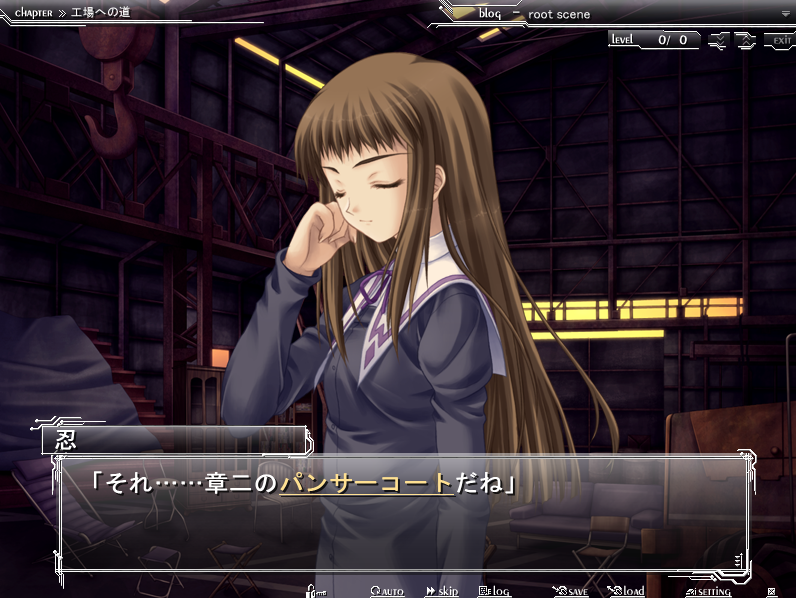
Saihate no Ima is a story built around these sorts of “fractures” of the narrative. The yellow hyperlinks scattered throughout the novel function almost like another layer of narration. They reshape the way you experience the story itself, turning information that would normally exist outside the narrative into part of the act of reading. They take those already fragmented pieces and reveal that they are connected to even more fragments, pulling you away from the immediate moment and sending you into another memory, another explanation, or another fragment of the world that exists outside of the scene you were just reading.
There are moments where these digressions feel almost like Romeo simply opening a door into his own interests and inviting you to look inside. One moment, Shinobu might simply be going through an ordinary part of his day, only for a hyperlink to lead into an extensive explanation about something like medicine, public health systems, or the history and structure of some obscure concept. Another link might instead lead into a more personal fragment—a memory, a conversation, or a small moment from the past that suddenly adds another layer to a character. Then there are stranger ones, where Romeo's curiosity seems to take complete control. A passing mention of a piece of music might lead into a hyperlink explaining its background, only for that explanation itself to contain another link that takes you even further. For example, a record player might be playing Erik Satie's Gymnopédie No.1, which prompts a hyperlink about the piece, only for that same hyperlink to contain another link leading into a digression-within-a-digression exploring Satie himself—his early compositions, his involvement with the Rosicrucian movement, his relationship with other artists, and the development of his unusual musical philosophy. It is the kind of information that has no immediate obligation to the plot at hand, yet it somehow contributes to the strange “texture” of the world Saihate no Ima creates.
In a way, it kind of feels like a dream, or perhaps, it mimics the way we navigate the web itself. You are on my article right now (or, if this is posted elsewhere, then perhaps not), but after reading this, you might click on another article completely unrelated to what you were originally looking for. Then maybe you drift onto YouTube, social media, or some completely unrelated corner of the internet, following one link that catches your interest, then another, and another, until eventually you find yourself somewhere completely detached from where you started. A single thread branches into countless others, and the original path becomes increasingly difficult to trace. This is the strange beauty of Saihate no Ima: it captures that same feeling of wandering through a web of connections, where every fragment leads somewhere else, where one topic suddenly spills into another before eventually dissolving into something entirely different. It is like wandering through a vast network of memories, information, and associations, never quite certain where the path will lead next, but still following it nonetheless.
Thank you for reading.
References
Xuse. (2015). 最果てのイマ -COMPLETE- ダウンロード版 (Saihate no Ima -COMPLETE- Download Edition) [Windows visual novel]. Xuse.